Want to be in the loop?
subscribe to
our notification
Business News
MOF EASES REGULATION FOR TAX REFUND
Deputy Minister Do Hoang Anh Tuan said that 287 businesses across the country were waiting for tax refunds but there are both objective and subjective reasons for the delay.
One of the reasons is that some enterprises owe the State budget but the State budget must also refund tax to these enterprises. However, under current regulations, the two debts are not allowed to be offset, so enterprises are required to settle debts with the State budget before receiving tax refund.
According to Tu?n, there are 20 enterprises facing this situation.
The ministry officially abolished the regulation via a document sent to local tax offices on Monday.
The ministry’s leader also asked the General Department of Taxation (GDT) to check and inform local tax agencies within 6 working hours upon receiving their proposals for tax refund approval.
If they receive approval, the agencies would then issue a decision to refund tax to enterprises and update the tax payers database.
Local tax offices must take full responsibilities if they are slow in refunding tax to enterprises, Tu?n said.
However, the ministry still requests localities to delay the tax refund if they detect any breaches of tax or customs regulations committed by companies or if tax payers are unable to prove the eligibility of the tax amount declared in their applications.
Tuan added that some businesses which were under scrutiny also have to be put in the waiting list.
Another reason for the tax refund delay is that some localities do not have enough funds to return to enterprises.
Nguyen Thi Tuyet, general director of the Nhat Tri Thanh Company which specializes in supply materials for the metallurgy industry, said the firm should have received VNÐ38 billion ($1.7 million) of tax refunds by the end of January, but due to a shortage of money, the local tax office delayed the refund until the beginning of February.
Nguyen Huu Quang, an official from the National Assembly’s Finance and Budget Committee, said a delay like this was not rare.
Deputy head of central Ða Nang City’s tax authority Nguy?n Ðình Ân said that there are 5-6 pending applications at his office because of capital shortages. Normally, due to the limited quota set for each locality, the GDT would approve the refund in accordance with the order of priority such as type of business, export and big investments.
Tuan said that the ministry had enough resources for tax refunds nationwide. Currently, funds reserved for tax refund total VNÐ3.8 trillion (US$173 million). However, he did not deny the possibility that “This man has much to eat but that man finds no small piece.”
He said HCM City now had only VNÐ92 billion ($4.2 million) in the reserve while it needed VNÐ800-900 billion ($36-41 million) for tax refunds. In contrast, the central Hà Tinh Province has VNÐ1.1 trillion ($50 million).
To fix the problem, the ministry would remove quotas set for each locality and be more flexible in allocating funds for tax refunds.
Ðinh Nho Hau, head of the Hà Tinh Province’s tax office, said that the changes in tax refund regulations would help tackle difficulties for both local tax offices and businesses.
He also suggested that there should not be any discrimination among enterprises. Tax offices should repay tax to enterprises right after they complete procedures applying for the refund, regardless if they are big exporters or investors.
Over the past two months, 3,100 applications were sent to local tax agencies and all of the enterprises successfully reclaimed tax with total amount of funds worth VNÐ13 trillion ($591 million). This year, the Government set aside VNÐ98 trillion ($4.5 billion) for tax refunds.
Source: VNS
Related News

MEMBER CORNER / PROMOTIONS
AN ELECTRIFYING NIGHT WITH THE "QUEEN OF DANCE" THU MINH AT THE GRAND HO TRAM!
The stage at The Grand Ballroom is set to catch fire as Vietnam’s undisputed "Queen of Dance," Thu Minh, takes the spotlight. Renowned for her powerhouse vocals, magnetic stage presence, and sultry, high-energy performances, Thu Minh promises an evening of pure musical euphoria. The energy escalates with an exclusive appearance by special guest and The Voice champion, Vu Thao My.

HR / LABOUR/ EMPLOYMENT
HIGH-QUALITY HUMAN RESOURCES NEEDED TO ATTRACT NEW TECH INVESTMENT CAPITAL
Besides infrastructure, Việt Nam must also rapidly develop a highly skilled workforce to attract investment in AI, semiconductors and advanced manufacturing, experts have said. Don Lam, CEO and co-founder of investment management company VinaCapital, said that global technology investors were increasingly looking at the readiness of the entire ecosystem, with high-quality human resources a decisive factor.

HR / LABOUR/ EMPLOYMENT
HIRING OUTLOOK STRENGTHENS IN Q4 AS SKILLS SHORTAGES PERSIST
Hiring intentions among employers in Việt Nam strengthened in the fourth quarter, with 52 per cent of surveyed companies planning to increase headcount between October and December, according to a ManpowerGroup survey released this week. Việt Nam's hiring outlook was stronger than the Asia Pacific and Middle East (APME) regional average of 33 per cent and the global average of 29 per cent, ranking third in the region and 11th globally among 42 markets surveyed.

BANKING / FINANCE / INSURANCE / TAX
LARGE BANKS FORECAST TO GAIN HIGHER PROFITABILITY IN H2 2026
The return on average assets (ROAA) of the banking sector will likely remain stable at around 1.5 per cent in the second half of 2026, but profitability divergence among banks will increase, with large banks outperforming peers on stronger margins and diversified earnings, analysts forecast. In a recent report on the banking sector, analysts from the Vietnam Investors Service Rating said the sector’s ROAA rose by 10 basis points quarter-on-quarter to 1.51 per cent in the first half of this year, driven by net interest margin (NIM) improvements at some State-owned banks and large private banks.
GARMENT / TEXTILE
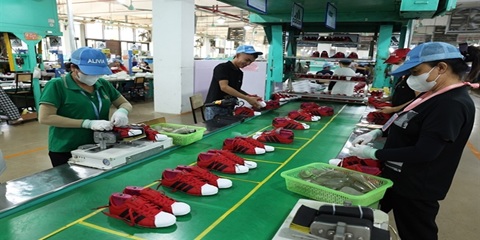
VIỆT NAM'S FOOTWEAR, BAG EXPORTS TO US TOP $8 BILLION IN EIGHT MONTHS
Việt Nam's exports of footwear and handbags to the US exceeded US$8 billion in the first eight months of 2026, as the US and EU remained the country's biggest markets despite sluggish growth in footwear shipments. Exports from Việt Nam's leather and footwear sector reached more than $2.45 billion in August, down 9 per cent from July but up 3 per cent from a year earlier, according to preliminary statistics.

VIETNAM ECONOMY INVESTMENT
LÂM ĐỒNG TARGETS DIGITAL ECONOMY TO ACCOUNT FOR 30 PER CENT OF GRDP BY 2030
Lâm Đồng Province aims to raise the digital economy’s contribution to around 30 per cent of its gross regional domestic product (GRDP) by 2030, as part of a five-year plan to develop digital economy and society issued recently. Under Plan No. 15358/KH-UBND, the province targets more than 60 per cent of small- and medium-sized enterprises (SMEs) to adopt digital technologies by 2030 while increasing the value of cashless payments to 30 times its GRDP.
Events Sponsors






















